Attorney-Verified Transfer-on-Death Deed Template for the State of Nevada
The Nevada Transfer-on-Death Deed form serves as an important estate planning tool that allows property owners to designate beneficiaries who will receive their real estate upon their death, without the need for probate. This form simplifies the transfer process, ensuring that the designated heirs can take ownership of the property directly, thereby avoiding the often lengthy and costly probate procedures. The deed must be executed and recorded during the property owner's lifetime to be effective. It includes essential information such as the names of the property owner and beneficiaries, a legal description of the property, and the owner's signature. Additionally, it is crucial to understand that the Transfer-on-Death Deed does not affect the property owner's rights during their lifetime; they can sell, lease, or mortgage the property as they see fit. Furthermore, the beneficiaries do not have any rights to the property until the owner's passing, providing peace of mind for the property owner. Overall, this form offers a straightforward solution for individuals looking to streamline the transfer of their real estate assets to their loved ones while minimizing complications for their heirs.
Nevada Transfer-on-Death Deed Sample
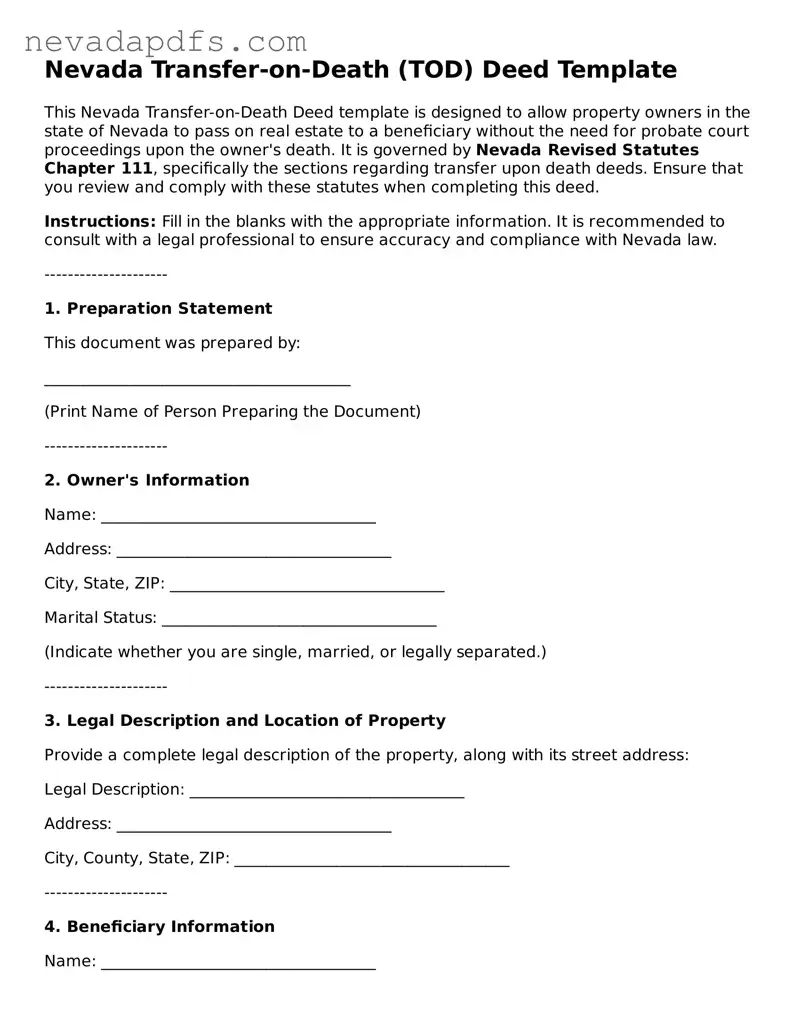
Nevada Transfer-on-Death (TOD) Deed Template
This Nevada Transfer-on-Death Deed template is designed to allow property owners in the state of Nevada to pass on real estate to a beneficiary without the need for probate court proceedings upon the owner's death. It is governed by Nevada Revised Statutes Chapter 111, specifically the sections regarding transfer upon death deeds. Ensure that you review and comply with these statutes when completing this deed.
Instructions: Fill in the blanks with the appropriate information. It is recommended to consult with a legal professional to ensure accuracy and compliance with Nevada law.
---------------------
1. Preparation Statement
This document was prepared by:
_______________________________________
(Print Name of Person Preparing the Document)
---------------------
2. Owner's Information
Name: ___________________________________
Address: ___________________________________
City, State, ZIP: ___________________________________
Marital Status: ___________________________________
(Indicate whether you are single, married, or legally separated.)
---------------------
3. Legal Description and Location of Property
Provide a complete legal description of the property, along with its street address:
Legal Description: ___________________________________
Address: ___________________________________
City, County, State, ZIP: ___________________________________
---------------------
4. Beneficiary Information
Name: ___________________________________
Address: ___________________________________
City, State, ZIP: ___________________________________
Relationship to Owner: ___________________________________
---------------------
5. Transfer on Death
I, ___________________________, hereby designate the following beneficiary(ies) to receive my interest in the described property upon my death. This transfer does not take effect until my death, and I retain the absolute right to revoke or change this designation at any time.
---------------------
6. Signature and Date
This document must be signed and dated in the presence of a Notary Public or other authorized officer.
Owner's Signature: ___________________________ Date: _________
State of Nevada
County of ___________________
Subscribed and sworn to (or affirmed) before me on this ____ day of ____________, 20__, by _______________________________.
Notary Public/Authorized Officer Signature: ___________________________
Print Name: ___________________________
My commission expires: _________________________
Document Data
| Fact Name | Detail |
|---|---|
| Definition | A Transfer-on-Death (TOD) Deed allows property owners in Nevada to designate beneficiaries who will receive the property upon their death without going through probate. |
| Governing Law | The TOD Deed is governed by Nevada Revised Statutes (NRS) Chapter 111.109 to 111.241. |
| Eligibility | Any individual who owns real estate in Nevada can create a TOD Deed, provided they are at least 18 years old and of sound mind. |
| Beneficiary Designation | Property owners can name one or multiple beneficiaries. If multiple beneficiaries are named, the property is divided among them unless specified otherwise. |
| No Immediate Transfer | The transfer of property occurs only upon the death of the owner, allowing the owner to retain full control during their lifetime. |
| Revocation | A TOD Deed can be revoked or changed at any time before the owner's death. This is typically done by creating a new deed or a formal revocation document. |
| Recording Requirements | The TOD Deed must be recorded with the county recorder's office in the county where the property is located to be effective. |
| Tax Implications | Beneficiaries may be subject to capital gains taxes upon the sale of the property, but the value is stepped up to the fair market value at the time of the owner's death. |
| Limitations | Some types of property, such as joint tenancy properties or properties held in a trust, cannot be transferred using a TOD Deed. |
| Legal Advice | While a TOD Deed is a straightforward tool, consulting with a legal expert is advisable to ensure it aligns with your overall estate plan. |
Find Some Other Forms for Nevada
Nevada Eviction Notice Form - It provides a formal and legal way for landlords to communicate their intentions, ensuring no surprises in the eviction process.
Will Template Nevada - Distribute specific items, like heirlooms or sentimental pieces, to chosen individuals to honor your relationships and memories.
Utilizing a proper Illinois Operating Agreement template can significantly simplify the process of forming your LLC, ensuring that all members are clear on their roles and the company's operational guidelines.
Notarized Promissory Note Sample - By explicitly stating the governing law, it determines which state’s laws will apply in interpreting the agreement, essential for inter-state transactions.